If your business earns less than AED 50 million a year, you must start e-invoicing on 1 July 2027. Before that, you must appoint an Accredited Service Provider by 31 March 2027. That gives you about four months to choose a provider, and about seven months to be ready.
This is Phase 2 of the UAE e-invoicing program. It is the largest phase by number of businesses. Most SMEs, trading companies, family businesses and service firms are in it. Large businesses (Phase 1) go live on 1 January 2027, so providers and consultants will be busy in early 2027. Do not wait until March.
This guide tells you what the rules are, what changed in 2026, what the penalties are, and what to do until go-live.
Important: A PDF, a Word file, a scanned copy or an email is not an e-invoice. An e-invoice is a structured data file that a computer can read. It goes through an approved provider, not by email. (Ministry of Finance)
The Key Dates
The Phase 2 dates did not change in 2026. Only the Phase 1 provider deadline moved, from 31 July 2026 to 30 October 2026. Plan on the dates below.
| Phase | Who | Appoint a provider by | E-invoicing starts |
|---|---|---|---|
| Pilot | Selected businesses and volunteers | Not set | 1 July 2026 (already open) |
| Phase 1 | Revenue of AED 50 million or more | 30 October 2026 | 1 January 2027 |
| Phase 2 | Revenue below AED 50 million | 31 March 2027 | 1 July 2027 |
| Phase 3 | Government entities | 31 March 2027 | 1 October 2027 |
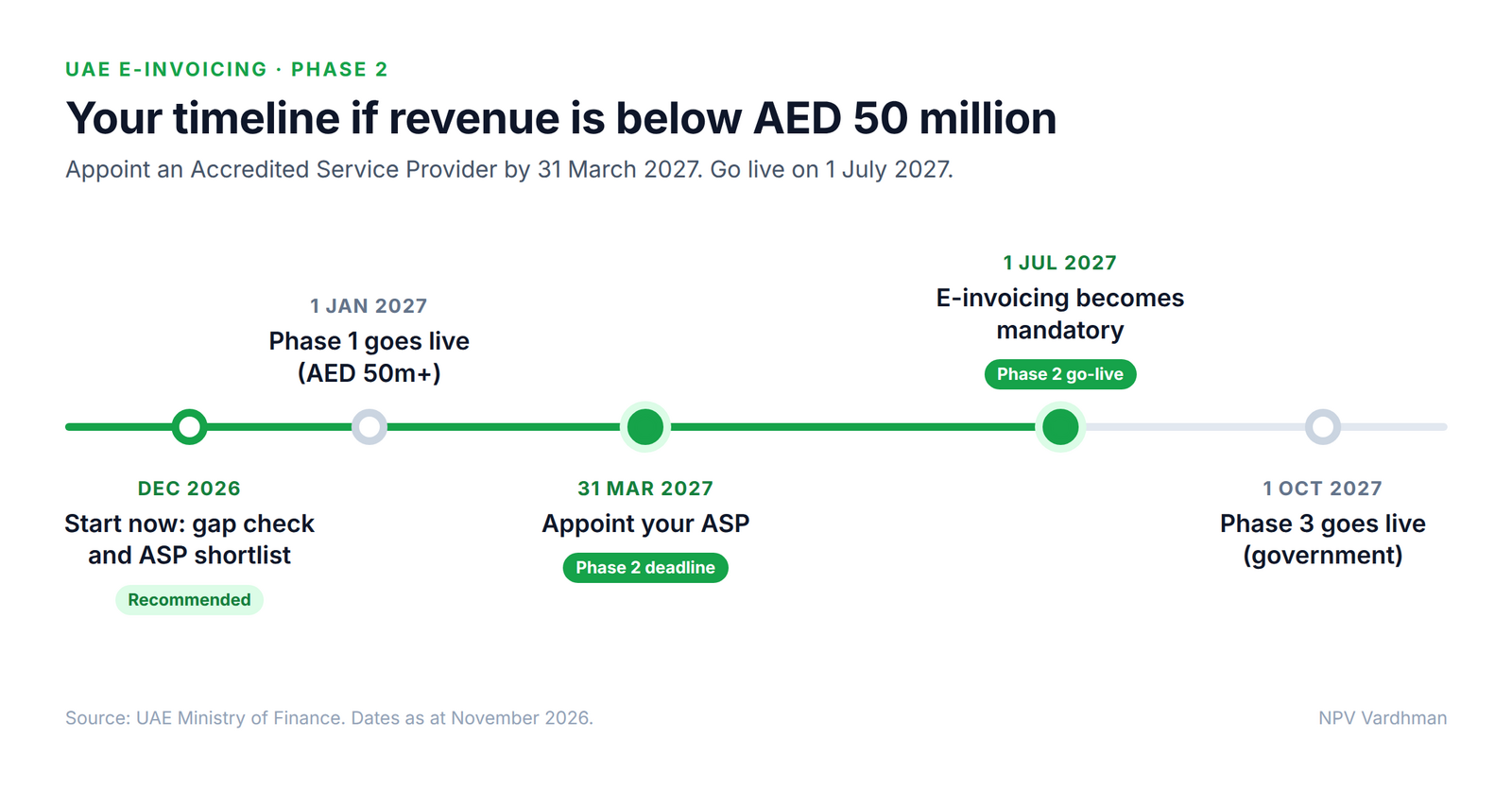
Practical point: You can join voluntarily before 1 July 2027. Voluntary users must follow the rules, but they pay no penalties until their mandatory date. An early start lets you find errors when they cost nothing.
Are You in Phase 2?
You are in Phase 2 if your revenue is below AED 50 million and you sell to other businesses or to the government. Use these four checks.
- Measure revenue correctly. Revenue is the gross income in your most recent accounting period. Use your audited financial statements, or other records the Federal Tax Authority (FTA) accepts. Include all income, also sales to consumers.
- VAT registration does not matter. The rules apply to businesses that are not registered for VAT too, unless the law excludes them.
- Look at who you sell to. The rules cover business-to-business (B2B) and business-to-government (B2G) sales. Sales to consumers (B2C) are not in scope at this time. A business that sells only to consumers is excluded.
- Check the excluded transactions. These are out of scope at this time:
- Government activity in a sovereign capacity that does not compete with private business
- International air passenger transport with e-tickets, and related airline extras
- International air cargo with airway bills (for 24 months)
- Financial services that are VAT exempt or zero-rated
- Sales between members of the same VAT tax group (for 24 months from 1 January 2027)
Practical point: If your revenue is close to AED 50 million, confirm your phase with your tax advisor now. A mistake here can put you six months late.
How the System Works
You do not send invoices to the government yourself. An Accredited Service Provider (ASP) does it for you. An ASP is a company that the Ministry of Finance has approved to send, receive and report e-invoices. The UAE calls this the "five-corner model".
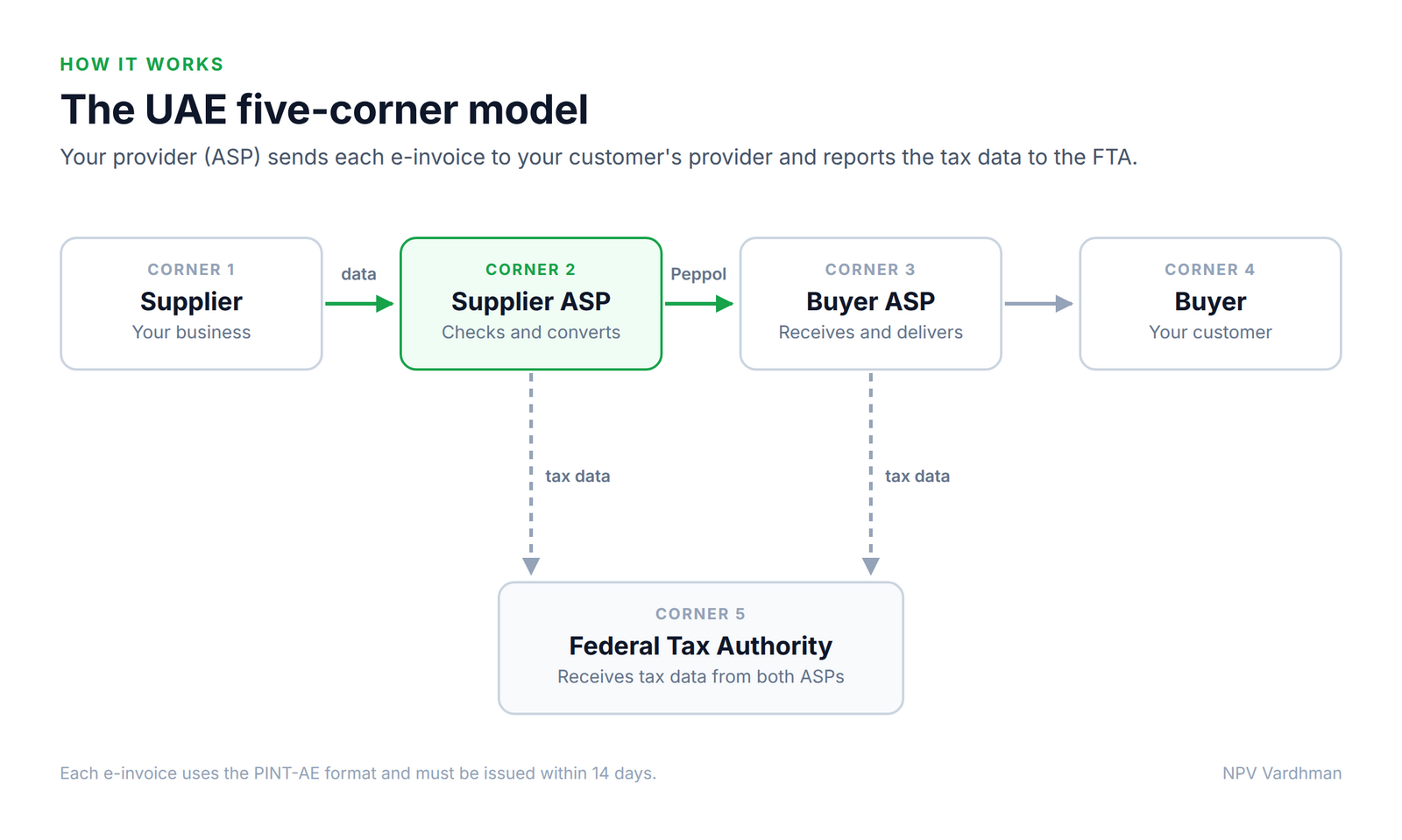
You send invoice data to your ASP. Your ASP checks it, converts it and sends it to your customer's ASP. Both ASPs report the tax data to the FTA.
Rules That Change Your Daily Work
- Format. Each e-invoice must use PINT-AE. This is the UAE version of the Peppol invoice format, a global standard for e-invoices. Your ASP converts your data into this format.
- 14-day rule. You must issue the e-invoice or e-credit note within 14 days of the date of the business transaction. That date is the earlier of the supply date or the date you receive payment.
- Credit notes. You correct an e-invoice with an e-credit note through the same system. You do not edit or cancel the invoice by hand.
- Input VAT. Your buyers need valid e-invoices to recover input VAT. A late or wrong e-invoice is a problem for your customer too.
- Records. Keep all e-invoices, e-credit notes and related data for the period in the Tax Procedures Law. Give them to the FTA when it asks. Since 1 October 2026, you can store them outside the UAE.
- Data fields. The Ministry publishes a list of mandatory fields. Compare it with the fields in your current invoices. Look closely at buyer data, for example the buyer's Tax Registration Number. See the Ministry of Finance e-invoicing page.
What Changed in 2026
The Ministry made the rules easier in 2026, but it did not move the Phase 2 dates. These are the changes that matter for Phase 2 businesses.
| Change | Decision | What it means for you |
|---|---|---|
| Tax group sales excluded for 24 months from 1 January 2027 | Ministerial Decision No. 197 of 2026 | Sales between members of one VAT tax group need no e-invoice until the end of 2028. Mark these sales in your system so they are not sent. |
| No duty to store data in the UAE | Ministerial Decision No. 197 of 2026 | You can use a cloud system hosted abroad. You must still keep the records and give them to the FTA when it asks. |
| No duty to report a system failure within 2 business days | Ministerial Decision No. 197 of 2026 | One compliance step is gone. You must still issue each e-invoice within 14 days. |
Ministerial Decision No. 197 of 2026 started on 1 October 2026. The Ministry also updated the rules for provider approval (Ministerial Decisions No. 56 and No. 168 of 2026), so the list of approved providers can change. Check the current list of accredited providers before you sign.
Insight: The Ministry extended the Phase 1 deadline by three months, but Phase 1 still goes live on 1 January 2027. Do not plan on an extension for Phase 2.
The Penalties
The largest fixed penalty is AED 5,000 for each month that you do not appoint a provider or do not start e-invoicing on time. Cabinet Decision No. 106 of 2025 sets these fines.
| Violation | Fine |
|---|---|
| No provider appointed, or e-invoicing not started, by the deadline | AED 5,000 per month |
| E-invoice not issued or sent on time | AED 100 per invoice, up to AED 5,000 per month |
| E-credit note not issued or sent on time | AED 100 per credit note, up to AED 5,000 per month |
| Provider not told about changes to your FTA registration data on time | AED 1,000 per day of delay |
| FTA not told about a system failure on time | AED 1,000 per day of delay |
Ministerial Decision No. 197 of 2026 removed the duty to report a system failure. Ask your advisor how the last fine applies now.
Practical point: The fines are small compared with the real cost. If your e-invoices are late or wrong, your customers cannot recover input VAT. They can delay payment until you correct the invoice. Cash flow is the bigger risk.
The Bottom Line
Phase 2 is not only a tax rule. It changes how you bill, how you get paid and how your customers recover VAT. The businesses that start in December 2026 will go live calmly. The businesses that start in March 2027 will compete for provider time with every other late business.
Your next step this week: confirm your revenue figure, list your invoice types, and ask your software vendor which approved providers it supports.
How NPV Vardhman Can Help
We help Phase 2 businesses from the first check to the first live e-invoice:
- Find the gaps in your ERP. We compare your current ERP setup and invoice data with the Ministry's mandatory fields and invoice types. You get a clear list of what is missing and what to fix.
- Tune your ERP. We help your team and your ERP vendor correct the fields, tax codes, credit note process and tax group settings. Your invoices are then ready for the 14-day rule.
- Select the right ASP. We help you compare approved providers on fit, cost and support, so you sign before 31 March 2027.
- Support you at go-live. We help you test each invoice type, train your team, and check the first weeks of live e-invoices against your VAT records.
To start with a gap assessment, contact us at info@vardhman.ae or +971 55 251 5774.
Disclaimer: This article gives general information. It is not legal or tax advice. Rules can change, so check the Ministry of Finance website and speak to your tax advisor.